If you’ve come across the term “transcript” in chats, emails, school discussions, or even social media, you might be wondering what it actually means.
Unlike slang like “LOL” or “BRB,” transcript isn’t exactly a trendy abbreviation but it’s still widely used in modern communication, especially in academic, professional, and digital contexts.
Understanding the transcript meaning is important because it shows up in education, job applications, video captions, meetings, and even online conversations.
In 2026, where everything is recorded, shared, and documented digitally, knowing how to use and understand this term can save you from confusion.
Let’s break it down in the simplest, most practical way possible 👇
What Does “Transcript Meaning” Mean? (Definition & Origin)
Simple Definition
A transcript is a written or typed record of spoken words.
In other words, it’s when something that was said out loud—like a conversation, lecture, or video—is converted into text.
Common Types of Transcripts
Here are the main ways the word is used:
- Academic Transcript → A record of your grades and courses
- Meeting Transcript → A written version of what was said in a meeting
- Video Transcript → Subtitles or captions of spoken content
- Chat Transcript → A saved conversation (like WhatsApp or support chats)
Origin of the Word
The word transcript comes from Latin:
- “trans” = across
- “scribere” = to write
So, it literally means “written across” or “copied into writing.”
How to Use “Transcript” in Texts or Chat
Even though “transcript” isn’t slang, people still use it casually in digital conversations.
Common Ways It Appears in Chat
- Requesting Information
- “Can you send me the transcript of the lecture?”
- “I need the interview transcript ASAP.”
- Referring to Saved Conversations
- “I checked the chat transcript, and you said yes.”
- “Support sent me the transcript of our conversation.”
- Content Creation & Social Media
- “Add a transcript to your YouTube video for SEO.”
- “Blog posts should include transcripts for accessibility.”
Where You’ll See It Most
- Emails 📧
- WhatsApp / Messenger chats 💬
- Online classes 🎓
- YouTube or podcast descriptions 🎧
- Customer support chats 🛠️
👉 Pro Tip: In texting, people don’t shorten “transcript”—they usually write it fully because it’s a formal word.
Examples of “Transcript” in Conversations
Let’s look at some real-life, relatable examples:
Casual Chat Example
Friend 1: Did you miss the class?
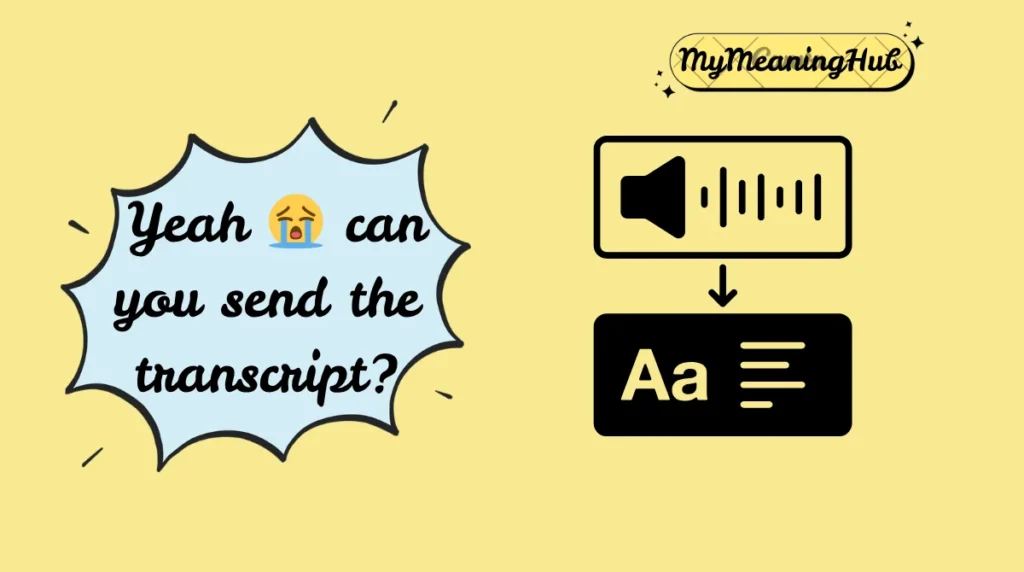
Friend 2: Yeah 😭 can you send the transcript?
Work Scenario
Manager: Please review the meeting transcript before tomorrow.
Employee: Got it, I’ll go through it today.
Online Content Example
“I prefer videos that include transcripts—it helps me understand better.”
Funny/Relatable Scenario 😂
“When you don’t attend the lecture but still ask for the transcript like you’ll actually read it later…”
Common Mistakes or Misunderstandings
Even though the word is simple, people often confuse it with similar terms.
❌ Mistake 1: Confusing Transcript with Translation
- Transcript = same language, written form
- Translation = different language
👉 Example:
- Transcript: English speech → English text
- Translation: English speech → Urdu text
❌ Mistake 2: Thinking It’s Only Academic
Many people think transcripts are only for schools—but they’re used everywhere now:
- Podcasts
- Interviews
- YouTube videos
- Customer service chats
❌ Mistake 3: Using It as Slang
“Transcript” is not slang or an abbreviation. It’s a formal word, even if used casually online.
Related Slangs or Abbreviations
While “transcript” itself isn’t slang, it connects to many modern digital terms.
Related Terms You Should Know
- CC (Closed Captions) → Text shown on videos
- Subtitles → Translated or same-language text in videos
- Logs → Recorded system or chat data
- Notes → Informal written summaries
- Recap → Short summary of events
Texting & Chat Abbreviations (Contextual Use)
These might appear alongside “transcript”:
- FYI → For Your Information
- ASAP → As Soon As Possible
- BTW → By The Way
- IDK → I Don’t Know
👉 Example:
“FYI, I uploaded the transcript. Check it ASAP.”
When Should You Use “Transcript”?
Understanding when to use the word transcript is just as important as knowing what it means.
Use It When:
✔ You’re talking about written records of speech
✔ You need proof or documentation
✔ You’re sharing educational or professional content
✔ You’re improving accessibility (like captions)
Avoid Using It When:
❌ You mean a short summary (use “summary” instead)
❌ You’re translating languages (use “translation”)
❌ You’re chatting casually about random topics
Practical Uses of Transcripts in 2026
In today’s digital-first world, transcripts are more important than ever.
1. SEO & Blogging
Adding transcripts to videos helps:
- Improve Google rankings
- Increase keyword visibility
- Boost accessibility
2. Online Learning
Students rely on transcripts for:
- Revising lectures
- Understanding complex topics
- Studying faster
3. Accessibility
Transcripts help:
- Deaf or hard-of-hearing users
- Non-native speakers
- People who prefer reading
4. Professional Use
Used in:
- Interviews
- Legal documentation
- Business meetings
Personal Insight: Why Transcripts Are Underrated
Honestly, most people ignore transcripts—but they’re incredibly useful. If you’ve ever rewatched a lecture just to catch one line, you’ll understand the value of having everything written down.
In my experience, transcripts make learning faster, clearer, and less stressful—especially when dealing with long videos or complex topics.
Internal Linking Suggestions (For SEO)
If you’re building a blog, link this article with:
- “What Does LOL Mean in Text?”
- “BRB Meaning in Chat Explained”
- “FYI Meaning and Usage Guide”
- “What Does IMO Mean?”
People Also Ask (FAQs)
What is the simple meaning of transcript?
A transcript is a written version of spoken words, like a lecture, conversation, or video.
Is transcript the same as subtitles?
Not exactly. Subtitles are shown on screen, while a transcript is usually a full written document.
What is an academic transcript?
It’s an official record of your grades, subjects, and academic performance.
Can a transcript be translated?
Yes. First, speech is transcribed into text, then it can be translated into another language.
Why are transcripts important in videos?
They improve accessibility, SEO, and user experience, helping more people understand the content.
Do people use “transcript” in texting?
Yes, but mostly in formal or semi-formal chats, like school or work discussions.
What’s the difference between transcript and summary?
A transcript includes everything word-for-word, while a summary is shorter and simplified.
Are transcripts useful for students?
Absolutely! They help with revision, note-taking, and better understanding.
Conclusion: Final Thoughts on Transcript Meaning (Updated for 2026)
To sum it up, the transcript meaning is simple but powerful it’s all about turning spoken words into written text.
Whether you’re a student, content creator, or professional, understanding this term can make communication clearer and more effective.
In 2026, transcripts are no longer optional they’re essential for learning, accessibility, and digital communication.
From classrooms to YouTube videos, they play a huge role in how we consume and share information.